Wyckoff on Gold: All 4 Accumulation Phases Explained Step by Step (with Charts)
Deep guide to each Wyckoff phase applied to XAU/USD. Phase A, B, C and D explained separately with diagrams, real examples and direct connection to SMC/ICT.
Why Wyckoff Still Matters in 2026
Richard Wyckoff developed his methodology over 100 years ago. And it still works.
Why? Because it describes how institutions accumulate and distribute positions. That hasn’t changed. The banks of the 1920s did exactly what today’s hedge funds do: buy cheap without anyone noticing, manipulate price to generate liquidity, and then move the market in their direction.
In this guide we’ll study each phase separately. Not as a quick flow, but as independent blocks you can identify on your chart without needing to see the complete schematic.

The full schematic has 4 phases. But you don’t need to see all 4 to trade. If you can identify just Phase C (the Spring), you already have a massive edge.
Let’s go phase by phase.
Phase A — Stopping the Downtrend
What’s happening here
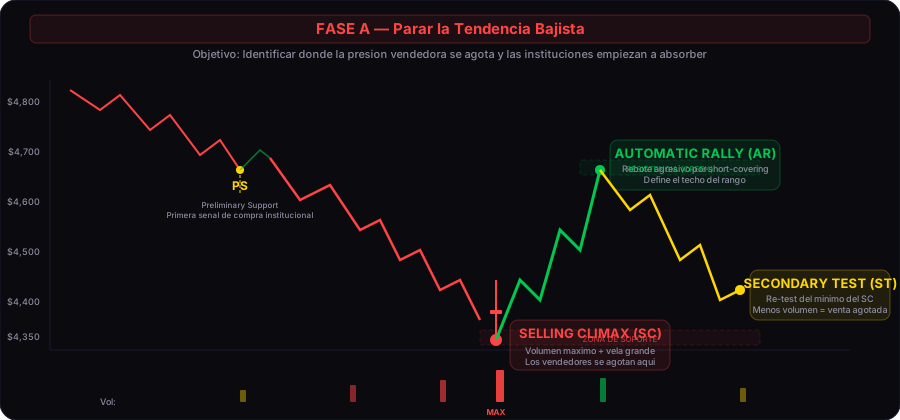
The downtrend reaches a point where sellers are exhausted. It’s not that buyers are stronger — it’s that there’s nobody left to sell.
Phase A has 3 key events that mark this exhaustion:
1. Preliminary Support (PS)
The PS is the first signal that something is changing. An unusual bounce appears in the middle of the downtrend.
How to identify it:
- Price has been falling consistently
- A bullish candle with a large body appears (larger than usual)
- Volume increases slightly but not dramatically
- Price bounces… but then continues falling
Common mistake: Confusing the PS with a bottom. It’s not. It’s only a preliminary signal. Price will keep falling. The PS tells you: “institutions started buying, but they’re not done yet.”
In SMC terms: The PS is equivalent to an Order Block that will be swept. Institutions buy here knowing price will drop further — they need it to fall so they can accumulate at lower prices.
2. Selling Climax (SC)
The SC is the most important event in Phase A. It’s the point of maximum capitulation.
How to identify it:
- HUGE bearish candle (the largest in the entire downtrend)
- Maximum volume — the highest you’ve seen in weeks
- Price drops to a level where all retail traders have already sold or been stopped out
- Long lower wick (institutions are absorbing all the selling)
What’s really happening: Retail traders are panic-selling. Institutions are on the other side buying everything. Every panic sell is an institutional buy. That’s why volume is at its peak — there’s massive activity on both sides.
In SMC terms: The SC is equivalent to a final bearish Displacement. The SC wick often marks the low of the entire structure (or very close to it).
How NOT to confuse it:
- If volume isn’t significantly higher than previous days, it’s not an SC
- If price keeps falling with the same momentum afterward, it wasn’t an SC — it was just another bearish candle
- A real SC is followed by an aggressive bounce (the AR)
3. Automatic Rally (AR)
The AR is the automatic bounce that occurs immediately after the SC.
How to identify it:
- Comes right after the SC
- Fast and aggressive bullish move
- High volume but lower than the SC
- Typically retraces 40-60% of the prior decline
Why it happens:
- Shorts start closing positions (short covering)
- Institutions that bought during the SC let price rise
- Selling pressure has temporarily disappeared
In SMC terms: The AR is equivalent to an impulsive rally with FVGs. The AR high defines the range resistance (what Wyckoff calls the “Creek”).
What the AR defines: The AR high becomes the resistance that price will test multiple times during Phase B. It’s a key level. Mark it.
4. Secondary Test (ST)
The ST is the confirmation that selling has been exhausted.
How to identify it:
- Price falls back toward the SC zone
- BUT with less volume and less momentum
- The candle isn’t as large as the SC
- Price stalls at the same zone or slightly above
What it confirms: If the ST has less volume than the SC, it means there are no sellers left. Those who were going to sell already did so during the SC. The market is now in institutional hands.
In SMC terms: The ST is equivalent to a re-test of the Order Block. The fact that price doesn’t break the SC low with force confirms institutional absorption.
Phase A Checklist
| Element | What to look for | Confirmation |
|---|---|---|
| PS | First unusual bullish candle in a downtrend | Slightly higher volume |
| SC | Huge bearish candle + maximum volume | Long lower wick |
| AR | Aggressive bounce from the SC | Retraces 40-60% of the decline |
| ST | Re-test of SC with less volume | Price holds the zone |
What you should NOT do in Phase A
- Don’t buy the SC. It’s tempting but there’s no confirmation yet
- Don’t assume the AR is the start of a trend. It’s just a bounce
- Don’t panic if the ST slightly breaks the SC low. That can happen — what matters is volume (it should be lower)
Phase B — Building the Cause
What’s happening here
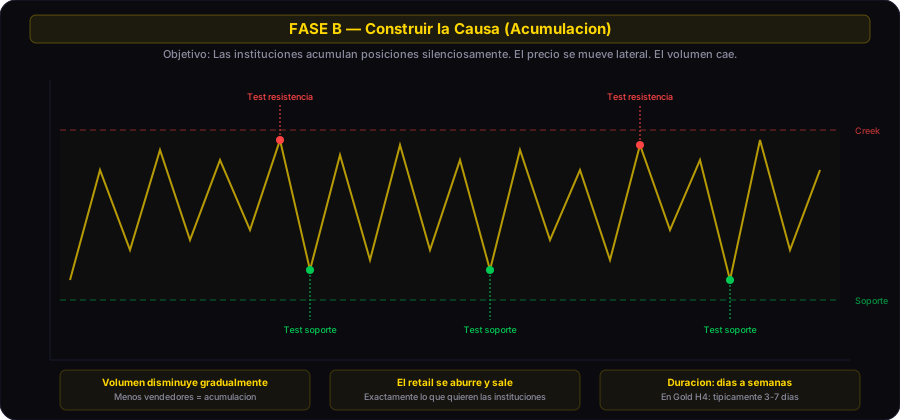
Phase B is the most boring phase — and the most important one for institutions.
Price moves sideways between support (defined by the SC) and resistance (defined by the AR). It can last days, weeks, or even months. On Gold H4, typically 3-7 days.
Why the range exists
Institutions need to accumulate a massive position without moving price. If they bought everything at once, price would spike immediately and their average cost would be terrible.
So they buy little by little, on every dip within the range:
- Price drops to support → they buy
- Price rises to resistance → they stop buying
- Price drops again → they buy more
- Repeat for days
The goal: accumulate the maximum number of contracts at the lowest possible price.
How to identify Phase B
Key signals:
- Price bounces between support and resistance without definitively breaking either
- Volume gradually decreases — each test of support and resistance has less volume
- Retail traders get bored and leave — exactly what institutions want
- Candles get smaller over time
On Gold: Look for sideways ranges of $30-80 on H4 that last 3+ days. Price touches support and resistance at least 3-4 times each.
Tests within Phase B
During Phase B you’ll see multiple “mini-sweeps” of support and resistance:
Support tests:
- Price drops to support with low volume → bounces
- Each test with less volume = confirmation that demand holds
- In SMC: each test is a partial mitigation of the demand OB
Resistance tests (Upthrusts):
- Price rises to resistance and briefly breaks it → drops back
- This sweeps stops from shorts who entered at resistance
- In SMC: each false breakout is a sweep of equal highs
The psychological trap
Phase B is designed to destroy patience:
- Traders who bought in Phase A see price going nowhere → they sell at breakeven or a small loss
- Breakout traders see constant false breakouts → they get frustrated
- Range traders get used to the chop → they let their guard down
All of this is intentional. Institutions need retail to lose interest so they can accumulate without competition.
Phase B Checklist
| Element | What to look for | Confirmation |
|---|---|---|
| Defined range | Price between SC low and AR high | 3+ touches on each extreme |
| Decreasing volume | Each test with less volume | Compare volume bars |
| Smaller candles | Candle range shrinks | ATR decreases |
| Duration | 3-7 days on Gold H4 | No maximum limit |
What you should NOT do in Phase B
- Don’t trade the range unless you’re an experienced scalper
- Don’t get impatient — Phase B ends when institutions decide, not when you want it to
- Don’t confuse false breakouts with trend starts — Phase B upthrusts are not BOS
Phase C — The Spring (The Trap)
What’s happening here
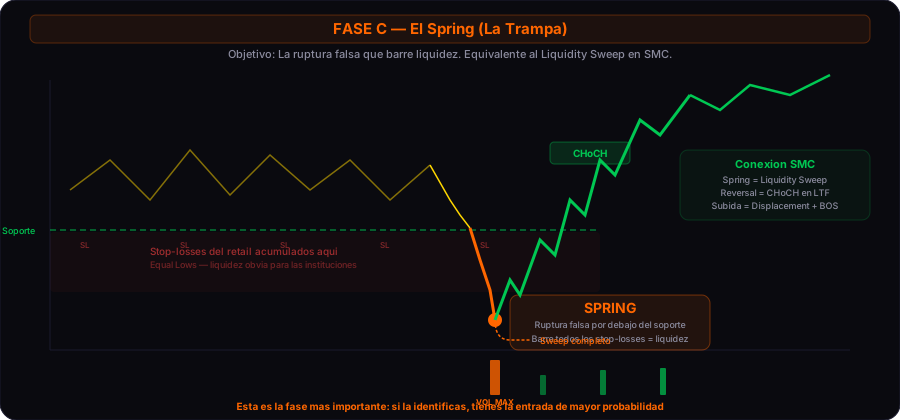
This is the most important phase of the entire schematic. If you understand Phase C, you understand 80% of how institutions operate.
The Spring is a false breakout below the support of the accumulation range. Price breaks down, sweeps all retail stop-losses, and then reverses violently to the upside.
The mechanics of the Spring
Imagine you’re a bank that has been accumulating positions for 5 days in a range of $4,400-$4,500.
You have a large position, but you need more liquidity to finish filling your orders. Where is that liquidity?
Below support.
Down there you’ll find:
- Stop-losses from everyone who bought within the range
- Sell orders from breakout traders who would sell if support breaks
- Stop-losses from longs who entered during Phase A
By pushing price below support, the bank triggers all of those orders. They’re sells — and the bank is on the other side, buying.
How to identify the Spring
Before the Spring:
- Price is in the lower part of the range (Phase B)
- Volume has been declining
- Support has been tested several times → stop-losses have accumulated just below
The Spring itself:
- Price breaks support aggressively
- There may be one or several candles below support
- Volume spikes sharply (stop-loss activation)
- Long lower wick — institutions absorb all the selling
Immediately after: 5. Price reverses sharply to the upside 6. A CHoCH forms on a lower timeframe (M5/M15) 7. Bullish displacement with FVGs 8. Price breaks the range resistance (Creek) → this is the SOS
Spring vs. Shakeout
Not all Springs are the same:
| Type | Depth | Volume | Probability |
|---|---|---|---|
| Spring (ideal) | Barely breaks support (1-2 candles) | High but absorbed | Highest — immediate reversal |
| Shakeout | Breaks deep (3-5 candles below) | Very high | High — but scarier |
| Terminal Shakeout | Breaks and keeps falling | Sustained volume | May NOT be a Spring — be careful |
The key: If price breaks support but volume is absorbed (candles close with long wicks), it’s a Spring. If volume stays high and candles close at the lows, it could be a real breakdown.
Direct connection to SMC
| Wyckoff | SMC/ICT |
|---|---|
| Spring | Liquidity Sweep |
| Support break | Sweep of equal lows |
| Post-Spring reversal | CHoCH on LTF |
| Post-Spring rally | Displacement + FVGs |
| Absorption at the Spring | Institutions filling orders at an Order Block |
If you already understand Liquidity Sweeps in SMC, you already understand the Spring. They’re the same concept with a different name.
Where to place your entry
In classic Wyckoff: You buy when price returns to support after the Spring (the Test of the Spring).
In SMC (more precise):
- Wait for the Spring (sweep of support)
- Drop to M5
- Look for a bullish CHoCH
- Enter at the FVG or OB that caused the CHoCH
- SL below the Spring low
- TP at the Creek (range resistance)
Phase C Checklist
| Element | What to look for | Confirmation |
|---|---|---|
| Support break | Price breaks Phase B low | With high volume |
| Absorption | Long lower wicks | Candles close inside the range |
| Reversal | Fast move back to the upside | CHoCH on LTF |
| Volume | Spike followed by absorption | Doesn’t stay high |
| Time | Lasts hours, not days | 1-6 candles on H4 |
What you should NOT do in Phase C
- Don’t sell the bearish “breakout” — that’s exactly what institutions want
- Don’t enter without confirmation — wait for the CHoCH, don’t try to guess the bottom
- If price keeps falling for 24h+ with volume, get out — it may not be a Spring
Phase D — Markup (The Trend)
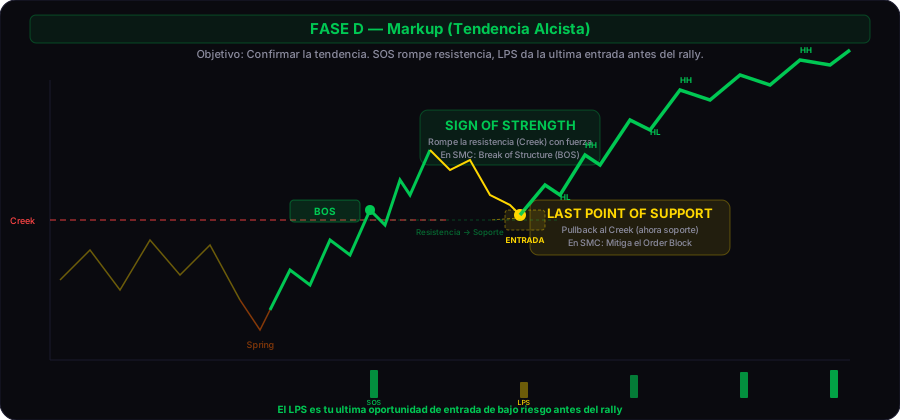
What’s happening here
Phase D is where you finally see results. Institutions have finished accumulating and now they let price rise.
Phase D has two key events before the full rally:
1. Sign of Strength (SOS)
The SOS is the moment where price breaks the range resistance (the Creek) with force and volume.
How to identify it:
- Large bullish candle that breaks the AR high (the Phase B resistance)
- High volume — higher than any candle in Phase B
- Price closes ABOVE resistance (not just touches it)
- FVGs are left below
In SMC terms: The SOS is a confirmed Break of Structure (BOS) to the upside. It’s the first time structure officially shifts from bearish to bullish on HTF.
Common mistake: Buying the SOS. It’s valid, but the R:R isn’t optimal. The SOS confirms the trend, but the LPS gives you the best entry.
2. Last Point of Support (LPS)
The LPS is the last low-risk entry opportunity.
How to identify it:
- After the SOS, price pulls back
- The pullback stops at the zone where resistance used to be (the Creek)
- What was resistance is now support — polarity principle
- Low volume on the pullback (there are no real sellers)
- Small candles, no bearish displacement
In SMC terms: The LPS is equivalent to mitigating an Order Block or reacting at an FVG left by the SOS. It’s the classic pullback to a POI before continuation.
How to enter at the LPS:
- Wait for the pullback after the SOS
- Look for price to reach the Creek (now support)
- On M5, look for a bullish CHoCH
- Enter at the FVG/OB that caused the CHoCH
- SL below the LPS
- TP: open target — the trend has just started
After the LPS: The Markup
Once SOS and LPS are confirmed, price enters the markup phase:
- Consistent Higher Highs and Higher Lows
- High volume on rallies, low volume on pullbacks
- Corrections are shallow (don’t retrace more than 50%)
- In SMC: bullish structure with consecutive BOS events
On Gold: Markups after Wyckoff accumulations can be $100-$300 in just a few days. A 5-7 day accumulation often produces rallies of 2-3 days of the same magnitude.
Phase D Checklist
| Element | What to look for | Confirmation |
|---|---|---|
| SOS | Creek breakout with volume | BOS on H4 |
| LPS | Pullback to Creek with low volume | CHoCH on M5 |
| Markup | Consecutive HH + HL | High volume on impulses |
| Duration | 2-5 day rally on Gold H4 | Correlations confirm |
Putting It All Together
You don’t need to see all 4 phases to trade. In fact, if you wait to see all 4 phases clearly, you’ll often be late.
The practical strategy
- Identify Phase B — look for sideways ranges of 3+ days on H4 with decreasing volume
- Wait for Phase C — the Spring. Price breaks support and reverses. This is your opportunity
- Enter with SMC — CHoCH on M5 after the Spring → enter at FVG/OB
- TP at the Creek — first conservative target
- If it breaks the Creek (SOS) — let it run. The markup can be huge
Not every range is Wyckoff
A sideways range isn’t always accumulation. It can be:
- Distribution (the inverse schematic — they sell instead of buy)
- Re-accumulation (a pause within an uptrend)
- Simple indecision with no institutional accumulation
The difference: Volume. In accumulation, volume decreases during Phase B and explodes at the Spring. If volume doesn’t follow this pattern, it’s not Wyckoff.
Real Example: XAU/USD March 2026
Everything you just read happened on Gold less than a month ago. The March 2026 crash is a textbook Wyckoff accumulation scheme.
The Context
Gold hit an ATH of $5,595 on January 29, 2026. From there it started falling. In March, the Fed turned hawkish, the dollar surged, and Gold dropped 24% in 3 weeks — its worst weekly drop since 1983.
Real Candles (Daily)
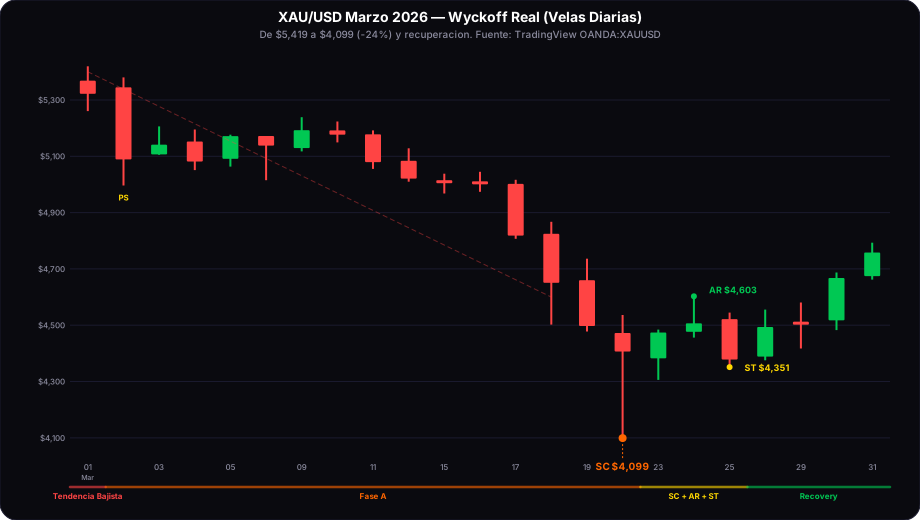
Each candle is a real trading day on Gold. Data from Capital.com.
What you see on the chart:
| Date | Wyckoff Event | Price | What happened |
|---|---|---|---|
| Mar 2-18 | Downtrend | $5,405 → $4,830 | Gradual decline, each day closing lower |
| Mar 19 | Preliminary Support | $4,830 → $4,554 | $276 drop in one day — the largest. High volume |
| Mar 23 | Selling Climax | Low $4,100 | Maximum panic day. Wick to $4,100, closes at $4,404 — $300 wick |
| Mar 25 | Automatic Rally | Closes $4,549 | $450 bounce from the low. Massive short-covering |
| Mar 26 | Secondary Test | Low $4,375 | Re-test of SC area. Less volume than the 23rd — confirmation |
| Mar 27-31 | Range / Phase B start | $4,490-$4,590 | Goes sideways. Institutions accumulate |
The Spring in Detail (1H Candles)
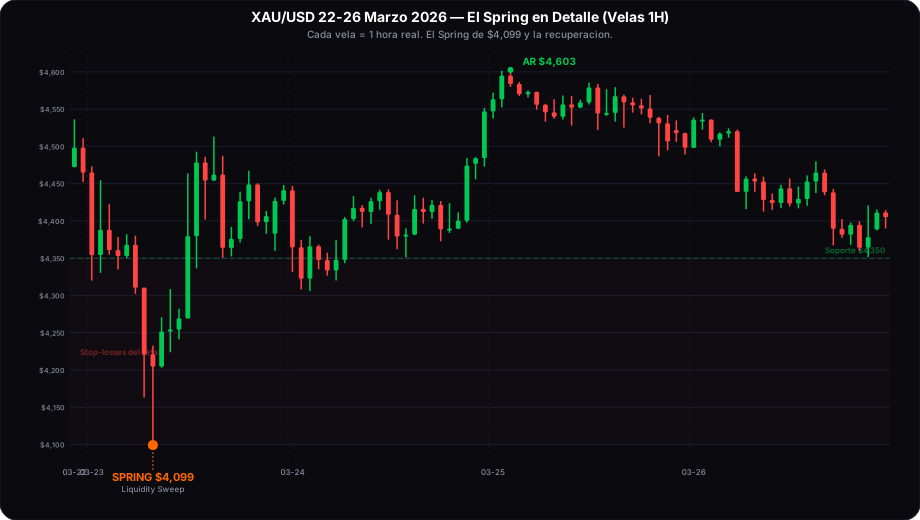
Here you can see every hour of the March 23 Spring:
- 00:00 UTC — Price opens at $4,466 and drops to $4,322 in the first hour
- 05:00-07:00 UTC — The drop accelerates: $4,370 → $4,166 → $4,100
- 07:00 UTC — The absolute low: $4,100. Massive wick. Institutions absorb all panic selling
- 08:00-11:00 UTC — Price reverses. CHoCH on M15. Rises from $4,100 to $4,466 in 4 hours
- 11:00-12:00 UTC — 1H candle of +$196: from $4,270 to $4,466. This is the displacement. FVGs everywhere
In SMC terms:
- $4,100 = Liquidity Sweep (swept all SLs below $4,350)
- The 11:00 candle = Displacement + BOS
- The FVG between $4,270-$4,380 = entry zone for the re-test
What Happened After
From the $4,100 low on March 23, Gold rose to $4,749 by April 11 — a rally of $649 (+15.8%) in less than 3 weeks. Exactly as Wyckoff predicts.
If you identified the Spring on March 23 and entered at the LPS around $4,375 (the ST on March 26), with SL at $4,050 (below the Spring):
- Entry: $4,375
- SL: $4,050 (325 pips risk)
- Current TP: $4,749 (374 pips profit and counting)
- R:R: 1:1.15 and growing — the trend hasn’t ended yet
Additional Resources
- Glossary: Wyckoff — Quick reference
- Glossary: Market Maker — The Market Maker Model and its connection to Wyckoff
- Glossary: Liquidity Sweep — The SMC equivalent of the Spring
- How to Analyze XAU/USD with SMC — Our 7-step process
- Free SMC Indicators — Session and Order Block indicators for TradingView
Disclaimer
Educational and informational content. This is not financial advice or a buy/sell recommendation. Trading involves risk of capital loss. Past results do not guarantee future results. Do your own research (DYOR).